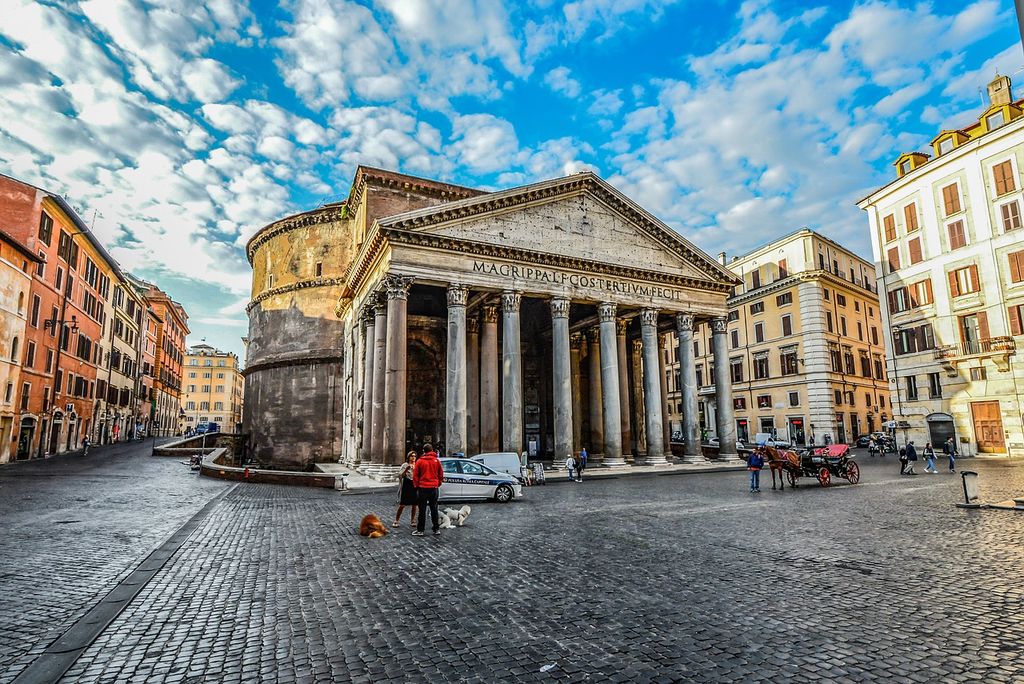
In the heart of Rome's historic center stands one of the most remarkable buildings to survive from antiquity: the Pantheon. Almost 2,000 years after it was built, its architecture and near-original condition still draw visitors in large numbers. For many people traveling to Rome, a visit here is one of the highlights of the trip.
History of the Pantheon in Rome
The Pantheon’s history goes back to the age of Emperor Augustus. Between 27 and 25 BC, Marcus Agrippa had the first temple built on this site. It was later destroyed by fire on more than one occasion. The building standing today was constructed under Emperor Hadrian, most likely between 118 and 125 AD. Although Hadrian had the Pantheon almost entirely rebuilt, the inscription on the portico was kept, and it still credits Agrippa to this day.
Originally, the Pantheon was dedicated to the Roman gods. In 609 AD, Emperor Phocas gave the building to Pope Boniface IV, who consecrated it as the church of Santa Maria ad Martyres. That conversion is one of the main reasons the Pantheon survived the centuries almost undamaged, while many other ancient buildings fell into ruin or were stripped for building material.
The Pantheon still functions as a church today. It’s also the burial place of significant historical figures, including the Renaissance painter Raphael and the Italian kings Victor Emmanuel II and Umberto I. That combination ties the history of ancient Rome to that of modern Italy in a way few other buildings can match.
Opening hours
The Pantheon is open year-round. The only closing days are January 1 and December 25. Last entry is 15 minutes before closing.
| Monday | 9:00 AM – 7:00 PM |
| Tuesday | 9:00 AM – 7:00 PM |
| Wednesday | 9:00 AM – 7:00 PM |
| Thursday | 9:00 AM – 7:00 PM |
| Friday | 9:00 AM – 7:00 PM |
| Saturday | 9:00 AM – 7:00 PM |
| Sunday | 9:00 AM – 7:00 PM |
| Jan 1 + Dec 25 | Closed |
| Public holidays (weekday) | 9:00 AM – 1:00 PM |
How long are the wait times at the Pantheon?
Since the Pantheon is the most-visited monument in both Rome and Italy, with over 7 million visitors a year, entry can involve noticeably longer wait times. The good news: even with the crowds, you shouldn’t have to wait longer than 60 minutes.
Tickets & Prices
As of July 3, 2023, the Pantheon can no longer be visited for free. Adults 18 and over pay €7.00 for admission. EU citizens between 18 and 25 pay a reduced €2.00. Visitors under 18 still get free entry.
| Adults (18+) | €7.00 |
| EU citizens (18–25) | €2.00 |
| Children & teens (under 18) | Free |
| Audio guide | €10.00 |
Where can I buy Pantheon tickets?
Tickets are sold at the ticket counters right at the Pantheon, though expect longer waits there given the demand. In theory, you can also buy tickets online through the Pantheon’s own website, but in practice that rarely works. The better alternative is external providers who sell tickets online and include an audio guide to the Pantheon in the price. These tickets also come with fast-track access, letting you skip the line.
Buy tickets online
Direct booking, flexible cancellation up to 24 hours before your visit.
Are guided tours of the Pantheon available?
Yes, there are. You can choose between a self-guided tour with an audio guide or having a guide on-site explain everything to you in person.
Directions & Location
The Pantheon sits in the heart of old Rome and is best reached on foot or by bus. There's no direct metro connection. On foot, it's just a few minutes from the Trevi Fountain or Piazza Navona.
On foot, no direct metro connection
Highlights – What to See
The Oculus, the Only Light Source
The circular opening at the top of the dome measures about eight meters across. It lets in daylight, and rain when it falls, creating the shifting light inside the Pantheon.
The Largest Unreinforced Concrete Dome of Antiquity
The dome was built without steel reinforcement. Its stability comes from graduated wall thickness and a concrete mix that changes composition to reduce weight toward the top.
The Royal Tombs and Raphael's Resting Place
The niches of the rotunda hold the tombs of Italian kings Victor Emmanuel II and Umberto I, as well as Queen Margherita. The painter Raphael is also buried in the Pantheon, at a grave still regularly decorated with fresh flowers.
The Monumental Portico
The portico, with its granite columns, forms the Pantheon's entrance. Its inscription still credits Marcus Agrippa, who built the original temple on this site.
Frequently Asked Questions
The Pantheon that survives today was built under Emperor Hadrian between 118 and 125 AD. It replaced an earlier temple, built by Marcus Agrippa between 27 and 25 BC, that was later destroyed by fire.
As of July 1, 2026, adults pay €7 admission. EU citizens between 18 and 25 pay €2. Minors and Rome residents get free admission.
Yes. A ticket has been required for entry since 2023. Booking online ahead of time is worth it, especially on weekends and during high season, to avoid long waits.
You can visit daily between 9 AM and 7 PM. Last entry is about 30 minutes before closing.
The Pantheon's dome is the largest unreinforced concrete structure to survive from antiquity. Its stability comes from graduated wall thickness and a concrete mix that was unusual for its time. Daylight enters the interior only through the oculus.