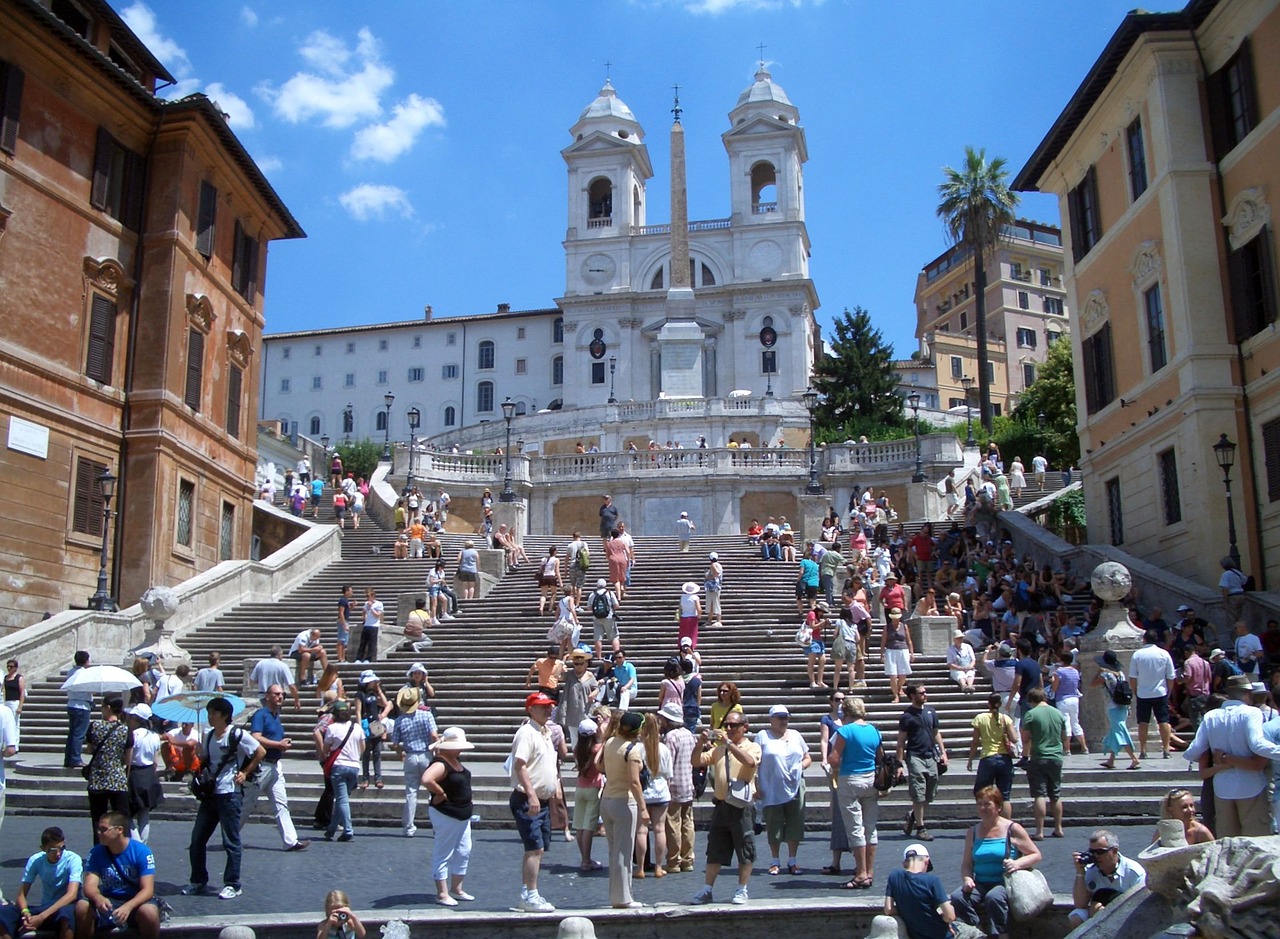
The 135 steps of the Spanish Steps begin in the middle of the Piazza di Spagna and lead up to the church of Trinità dei Monti. This Baroque staircase was completed in 1725 and is one of Rome's best-known landmarks today. From here, it's just a few steps to Via dei Condotti and many more of the old town's attractions.
History of the Spanish Steps in Rome
The Origins of the Spanish Steps (16th Century–1725)
As early as the 16th century, there were plans to connect the Piazza di Spagna with the higher-lying church of Trinità dei Monti. After several decades of political and financial delays, the project finally got underway in the early 18th century. It was made possible by a bequest from French diplomat Étienne Gueffier, who left money for the construction of a grand staircase. Following an architecture competition, Francesco de Sanctis won with his design. The 135 steps, with their sweeping flights and terraces, are considered one of the most important works of Roman Baroque architecture today.
From Connecting Path to Roman Landmark
After its completion in 1725, the Spanish Steps quickly became a popular gathering spot. They connect the Piazza di Spagna with the church of Trinità dei Monti and remain one of Rome’s most iconic sights. Every spring, hundreds of azaleas traditionally decorate the steps, giving the staircase a distinctive look for a few weeks.
Restoration and Protection of the Historic Site
The Spanish Steps have been restored several times to preserve them for the long term. The most extensive renovation to date took place in 2015 and 2016, with financial support from the Italian luxury company Bulgari. Specialists cleaned the travertine, repaired damage, and stabilized the historic structure. Since 2019, stricter protective rules have also been in place, including a ban on sitting on the steps, to help preserve the staircase over the long term.
Opening hours
The Spanish Steps are open to the public around the clock. Access to the steps may be temporarily restricted during restoration work or events such as fashion shows, though the staircase remains visible from the Piazza di Spagna at all times. As a public square, it's open year-round.
Tickets & Prices
There's no admission fee to visit the Spanish Steps. You can visit the staircase and the Piazza di Spagna free of charge at any time.
Directions & Location
The steps are close to Rome's historic center. By metro, you can reach the Piazza di Spagna, where the Spanish Steps are located, via Metro Line A. Get off at the "Spagna" stop. From there, a tunnel leads directly to the Piazza di Spagna; you just need to bear slightly left.
| Metro | A | Spagna |
Frequently Asked Questions
Construction began in 1723 under Pope Innocent XIII and was completed in 1725, designed by Italian architect Francesco de Sanctis after an architecture competition.
The name comes from the Spanish embassy that once stood at the foot of the steps on the Piazza di Spagna, while construction was actually funded by a bequest from the French diplomat \u00c9tienne Gueffier.
The staircase has 135 steps, is 68 meters long and 40 meters wide, and climbs a 23-meter difference in elevation between the Piazza di Spagna and the church of Trinità dei Monti.
No, sitting or lying on the steps has been banned by city ordinance since summer 2019, with fines ranging from €250 to €400 for violations.
At the top stands the French church of Santissima Trinità dei Monti, with an obelisk dating to 1789, while the Barcaccia Fountain sits at the bottom on the Piazza di Spagna.