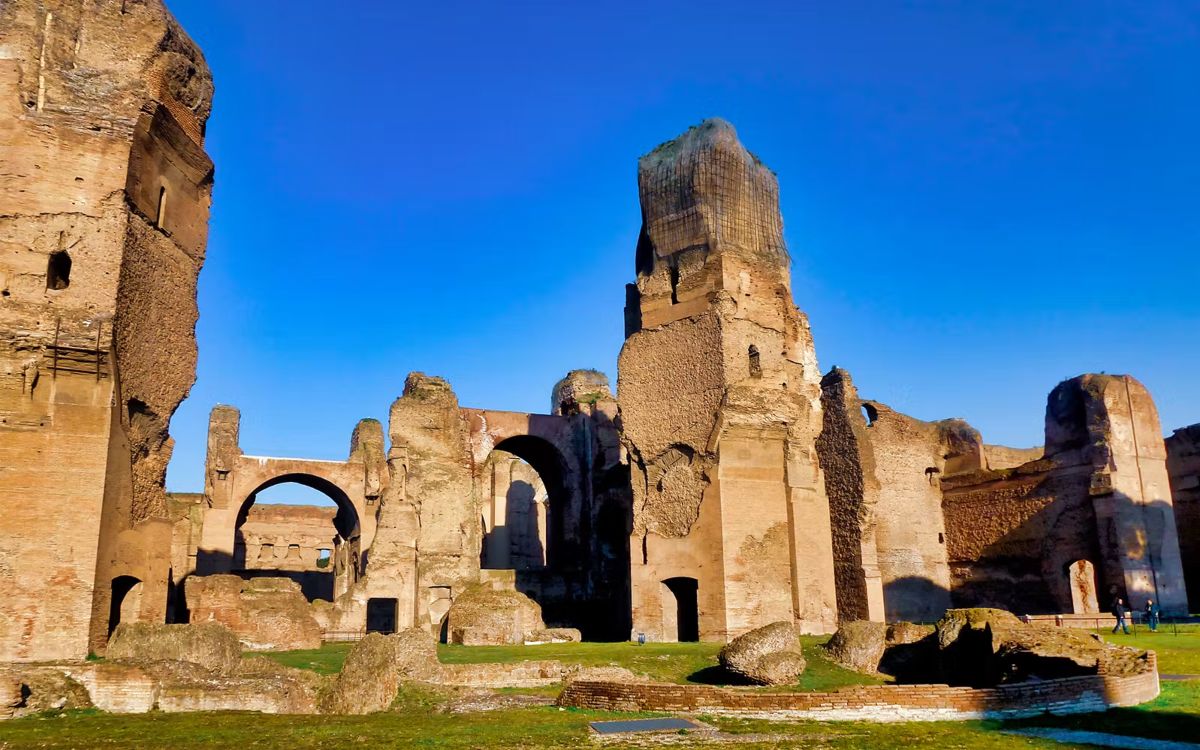
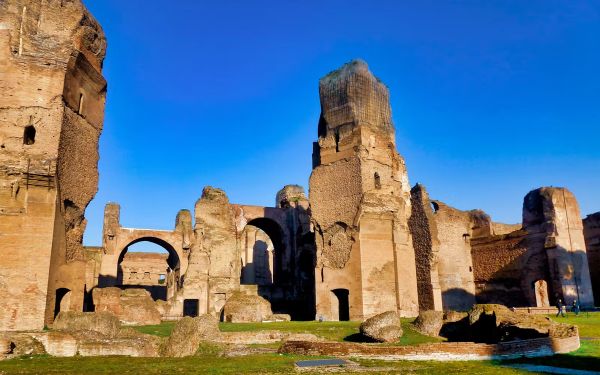
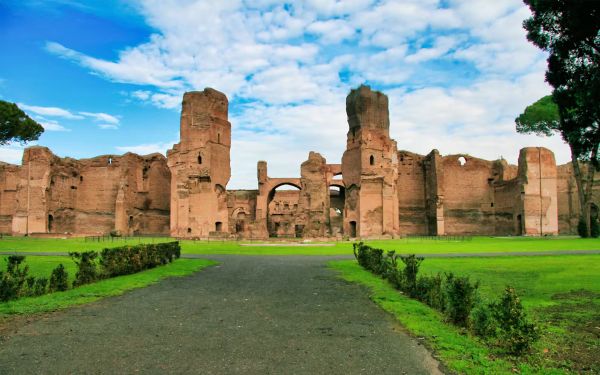
The Baths of Caracalla are among the largest surviving bath complexes of ancient Rome. Covering an area of roughly 337 by 328 meters, up to 1,600 people could bathe here at the same time. Today, the site is a sprawling ruin in the south of the city, just a few minutes' walk from the Circus Maximus.
History of the Baths of Caracalla
Planning for the baths began in 206 AD under Emperor Septimius Severus. His son and successor Caracalla dedicated the central bath block in 216 AD; officially, the complex was named Thermae Antoninianae. The outer structures, including the surrounding walls and the two semicircular exedrae, weren't completed until under Caracalla's successors Elagabalus and Severus Alexander, around 235 AD.
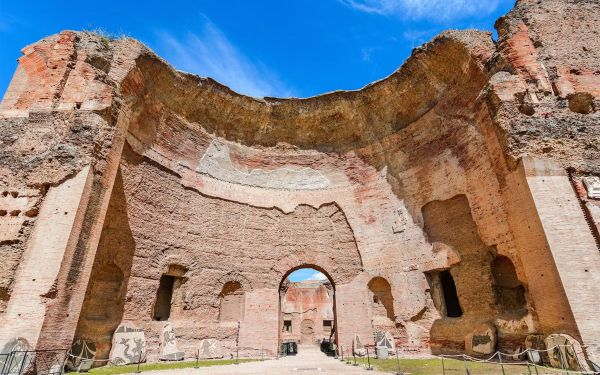
To supply the baths with water, a dedicated branch of the Aqua Marcia aqueduct was built, known as the Aqua Marcia Antoniniana. The complex followed the typical layout of the great imperial baths: the frigidarium, tepidarium, and caldarium sat along a central axis, flanked by two public libraries, one Greek and one Latin, along with gardens and a palaestra for exercise.
The baths stayed in operation for about 300 years, until the Ostrogothic king Vitiges cut the aqueducts during the siege of Rome in 537 AD. Without a water supply, bathing here came to a permanent end. Over the following centuries, the site was partly used as a quarry for new buildings in Rome.
In the 20th century, the open grounds of the baths hosted the gymnastics events of the 1960 Summer Olympics. For several decades now, the Rome Opera has also used the site for open-air performances during the summer months.
Opening hours
The Baths of Caracalla are open year-round, though Mondays run on a shortened schedule until 2:00 PM. On all other days, the site opens at 9:00 AM; closing time shifts with the season and follows dusk. The ticket counter closes one hour before the site does.
| Jan 2 – Feb 15 | 9:00 AM – 4:30 PM |
| Feb 16 – Mar 15 | 9:00 AM – 5:00 PM |
| Mar 16 – last Saturday in March | 9:00 AM – 5:30 PM |
| Last Sunday in March – Aug 31 | 9:00 AM – 7:15 PM |
| Sep 1 – 30 | 9:00 AM – 7:00 PM |
| Oct 1 – 25 | 9:00 AM – 6:30 PM |
| Oct 26 – Dec 31 | 9:00 AM – 4:30 PM |
Mondays run on the shortened 9:00 AM to 2:00 PM schedule year-round, except on Easter Monday. The site is closed on January 1, May 1, and December 25.
Tickets & Prices
Adults pay from €8.00 for admission to the Baths of Caracalla; the reduced price for EU citizens between 18 and 25 is €2.00. Children and teens under 18, as well as visitors with disabilities plus one companion, get free admission but still need to reserve a free ticket. During special exhibitions, a €5.00 surcharge may apply. On the first Sunday of every month, admission is free for everyone.
| Adults | from €8.00 |
| Reduced (EU citizens 18–25) | €2.00 |
| Children & teens (under 18) | Free |
| Special exhibition surcharge | €5.00 |
Where can you buy tickets for the Baths of Caracalla?
Tickets are available at the ticket counter on-site or online through the official booking site for Italy's state museums. Booking online locks in a fixed time slot and saves you the line at the counter.
Buy tickets online
Direct booking, flexible cancellation up to 24 hours before your visit.
The Mithraeum: Access to the Underground Levels
Rome's largest surviving Mithraeum sits in the underground vaults beneath the baths. Access is only possible on weekends, with advance online reservation and a surcharge of about €4.00 on top of the regular ticket. Step-free access to the underground level is through a separate entrance on Via Antoniniana 5, between 5:45 PM and 8:15 PM.
Directions & Location
The Baths of Caracalla sit in the Celio district, about 2 km south of the Colosseum. Take Metro Line B to the "Circo Massimo" stop; from there, it's about 600 meters, or a 10-minute walk, along Viale delle Terme di Caracalla. Several bus lines stop right at the entrance.
| Metro | B | Circo Massimo |
| Bus | 118, 160, 628, 760 | Terme di Caracalla |
Address: Viale delle Terme di Caracalla 52, 00153 Rome RM, Italy
Don't Miss These
Mithraeum
Beneath the former floor of the baths lies Rome's largest surviving Mithraeum, an underground temple for the Persian cult of Mithras. Access is only possible on weekends with advance reservation.
Floor Mosaics
Several rooms still hold original black-and-white mosaic floors depicting athletes and mythological scenes. They rank among the best-preserved examples of Roman bath decoration.
Natatio
The large open-air swimming pool formed the northwestern end of the main axis. The scale of the pool still conveys the sheer size the baths were built on.
Summer Open-Air Stage
During the summer months, the Rome Opera stages open-air performances on the grounds, with the ancient ruins as the backdrop.
What Should You Know Before Visiting the Baths of Caracalla?
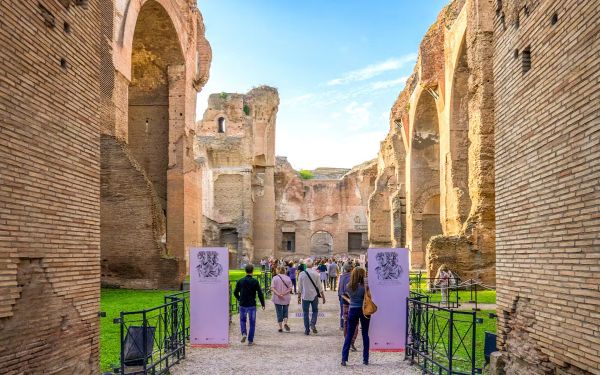
The ground on-site alternates between smooth stone, gravel, and ancient steps, so sturdy, closed-toe shoes are worth wearing. Since large parts of the site have no shade, bring water and a hat on warm days. There's a security check with a metal detector at the entrance, and you'll need a valid ID or passport with you.
Around Easter and Ferragosto (August 15), things get especially busy between 11:00 AM and 1:00 PM, with school groups and longer lines at the ticket counter. Early morning or late afternoon is quieter. In summer, regular opening hours can shift on individual days because of the open-air opera performances.
Photo Gallery
Frequently Asked Questions About the Baths of Caracalla
The full complex measures about 337 by 328 meters, making it one of the largest bath complexes of ancient Rome, surpassed only by the later Baths of Diocletian.
No. Access to the underground Mithraeum is only possible on weekends with advance reservation, and it costs a surcharge on top of the regular ticket.
Yes, on that day admission to the Baths of Caracalla is free, just like at all state museums and archaeological sites in Italy.
Take Metro Line B to the Circo Massimo stop, then it's about a 10-minute walk along Viale delle Terme di Caracalla.
Yes, in summer the Rome Opera uses the site for open-air performances. Tickets for these are sold separately through the opera, not with regular museum admission.