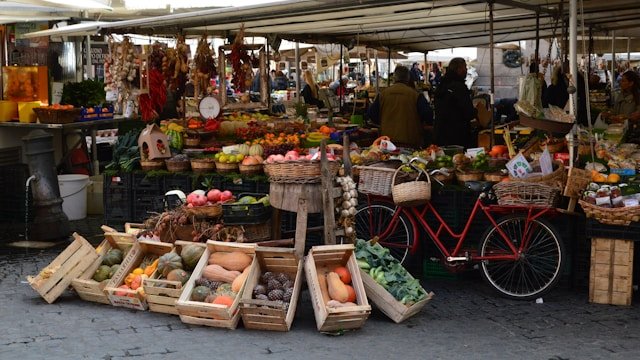
Campo de' Fiori sits south of Piazza Navona and is one of the few central squares in Rome without a church. A market has been held here by day since 1869, when it moved over from Piazza Navona. The stalls sell fresh fruit, vegetables, flowers, and local specialties. At night, the bars and cafés around the square fill up, and Campo de' Fiori turns into one of the busiest meeting spots in the old town.
History of Campo de' Fiori in Rome
Until the 15th century, Campo de' Fiori was an open meadow covered in wildflowers, which is where the name "field of flowers" comes from. In 1456, Pope Callixtus III had the area paved as part of the redevelopment of the Rione Parione district, and the Palazzo della Cancelleria and Palazzo Farnese were built in the neighborhood soon after.
In the 16th and 17th centuries, the square also served as a site of public executions. On February 17, 1600, the philosopher Giordano Bruno was burned at the stake here by the Inquisition on charges of heresy. In 1889, the city erected a monument to him in the center of the square, which still stands today.
The daily market as it exists today dates back to 1869, when the market previously held on Piazza Navona was moved here. Since then, Campo de' Fiori has been both a marketplace and, especially in the evening, a nightlife district with numerous bars and restaurants.
Opening hours
The market at Campo de' Fiori runs Monday through Saturday; the stalls stay closed on Sundays. The square itself is open to the public around the clock.
| Monday | 7:00 AM – 2:00 PM |
| Tuesday | 7:00 AM – 2:00 PM |
| Wednesday | 7:00 AM – 2:00 PM |
| Thursday | 7:00 AM – 2:00 PM |
| Friday | 7:00 AM – 2:00 PM |
| Saturday | 7:00 AM – 2:00 PM |
| Sunday | Market closed |
In the evening, the square turns into a nightlife district, with the surrounding bars and restaurants staying open well into the night.
What Does It Cost to Visit Campo de' Fiori?
Visiting Campo de' Fiori itself is free, since it's a public square open at any time of day or night. You can enjoy the square and its atmosphere at no cost, including the daily market held there.
Of course, if you plan to buy something at the market or eat at the surrounding shops and restaurants, expect to pay for it. Market prices are generally fair and reflect local standards, but as at any tourist destination, some items can be pricier, particularly ones aimed specifically at tourists.
Prices at the restaurants and cafés around Campo de' Fiori vary. You may pay a premium here for being in one of Rome's liveliest areas. It's worth checking menu prices before you sit down to make sure they fit your budget.
Food Tour: Trastevere, Campo de' Fiori & the Jewish Ghetto
This guided food tour links three of Rome's neighborhoods into one walk. It starts at Campo de' Fiori with local wine and Roman street food, before continuing through a hidden passage into the Jewish Ghetto. There, centuries-old recipes await, such as Jewish-Roman-style fried artichokes and a ricotta and cherry tart. The tour then crosses the Tiber into Trastevere, where porchetta, pasta all'Amatriciana, and gelato are on the menu, including a stop in a roughly 2,000-year-old wine cellar with a glass of prosecco.
The tour is led by local guides in small groups, who share the history of each neighborhood and its hidden corners along with the food.
Directions & Location
Campo de' Fiori sits in the middle of the historic center; there's no metro station right there. The closest stops are Spagna (Line A) and Colosseo (Line B), both about a 15 to 20 minute walk away.
Several bus lines stop at the surrounding stops Corso Vittorio Emanuele/Navona and Arenula/Cairoli, just a short walk from the square. Tram line 8 also stops at Arenula/Cairoli.
If you're already exploring the historic center, you can easily walk to Campo de' Fiori: the Pantheon and Piazza Navona are both just a few minutes away on foot.
| Bus | 46, 62, 64, 87, 916, 40, 70, 81, 23, 280 | C.So Vittorio Emanuele/Navona |
| Tram | 8 | Arenula/Cairoli |
Don't Miss These
Giordano Bruno Monument
Since 1889, a bronze statue in the center of the square has commemorated the philosopher who was burned at the stake here in 1600. The monument is still seen as a symbol of freedom of thought and scientific inquiry.
Morning Market
From 7:00 AM to 2:00 PM, vendors sell fresh fruit, vegetables, flowers, and specialties like dried mushrooms, spices, and oils. The market is liveliest in the early morning hours.
Palazzo della Cancelleria
This Renaissance palace right on the square was built shortly after Campo de' Fiori was paved in the 15th century and today houses Vatican administrative offices.
Nightlife
Once the market stalls come down, bars, wine bars, and restaurants take over the square. Late into the night, Campo de' Fiori remains one of the old town's busiest meeting spots.
Photo Gallery
Frequently Asked Questions About Campo de' Fiori
Yes, the square is public and free to visit around the clock; even the market only costs you whatever you choose to buy.
Sundays. On all other days, the market runs from 7:00 AM to 2:00 PM.
No, the nearest metro stations, Spagna and Colosseo, are both about a 15 to 20 minute walk away. Bus or tram are the faster alternative.
It commemorates the philosopher Giordano Bruno, who was burned at the stake at Campo de' Fiori in 1600 on charges of heresy. The monument was erected in 1889.
Once the market packs up, the surrounding bars and restaurants fill up. The square then becomes one of the old town's liveliest nightlife spots.