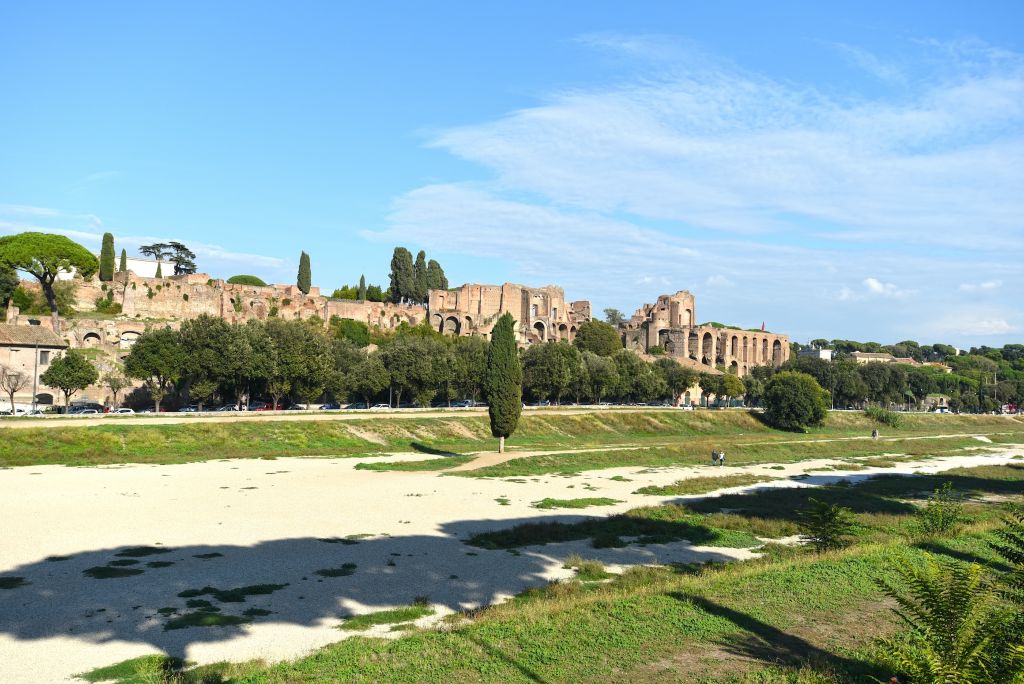
The Circus Maximus lies in the valley between the Palatine and Aventine hills and, at roughly 600 meters long, was the largest chariot racing track in the Roman Empire. Originally built for chariot races, the arena could hold hundreds of thousands of spectators. Today, only parts of the foundations and the outline of the former track survive, but the sheer scale of the site still makes clear how significant the Circus Maximus once was.
History of the Circus Maximus
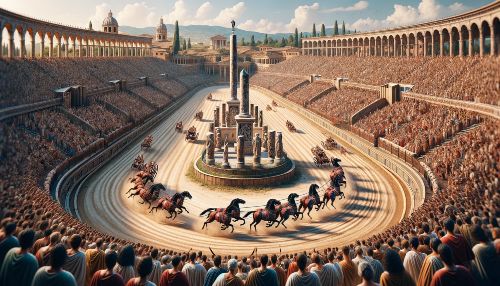
The history of the Circus Maximus goes back to Rome’s earliest days. According to tradition, public games and chariot races were already held here under Rome’s first kings. At first, the track was nothing more than an open stretch of land between the Palatine and Aventine hills.
Over the centuries, the Circus Maximus grew into the most important racetrack in the Roman Empire. Chariot races in particular drew huge crowds and were among the most popular public events in ancient Rome. Stone grandstands, starting gates, and the long central barrier known as the spina were gradually added.
Julius Caesar carried out a major expansion of the site in the 1st century BC. Emperor Augustus later expanded and embellished it further. After several fires, further rebuilding and restoration followed over the following centuries, and at times the track held space for more than 150,000 spectators.
Chariot racing ended along with the decline of the Western Roman Empire. The site was used for various purposes over the following centuries and gradually fell into disrepair. Today, the Circus Maximus serves as a public park and a venue for concerts, sporting events, and large festivals. Its sheer scale still makes it easy to see why the largest racetrack of antiquity once stood here.
Opening hours
The Circus Maximus can be visited 24 hours a day, 7 days a week. As long as there's no event taking place, the site is open at all times.
How long are the wait times at the Circus Maximus?
No wait times to plan for here. The site is so large that you can visit the Circus Maximus in Rome without any waiting at all.
Tickets & Prices
The Circus Maximus is free to visit and open to the public at all times. Several times a year, though, the site hosts concerts, sporting events, and other large gatherings. During these events, parts of the Circus Maximus may be temporarily closed off.
How do I get to the Circus Maximus?
The Circus Maximus sits centrally and is well served by public transport. It's just a few minutes' walk from the Circo Massimo metro station (Line B). On foot, it's also a short walk from the Colosseum or the Roman Forum.
Parking nearby is paid and limited, and driving in Rome generally isn't worth the hassle – public transport is the more practical choice here.
| Metro | B | Circo Massimo |
| Bus | 81, 85, 87, 118, 628 | Circo Massimo |
| Bus | 85, 87, 628 | Cerchi/Porta Capena |
| Bus | 51, 81, 85, 87, 118, 160, 628, 715, C3 | Cerchi/Bocca Della Verità |
| Tram | 3 | Aventino/Circo Massimo |
Virtual Reality Chariot Race at the Circus Maximus
In this virtual reality experience, you put on a VR headset and step straight into imperial Rome. On foot, you first make your way through the city streets, passing the Arch of Titus and the Septizodium, accompanied by digitally reconstructed Romans. At the high point, you find yourself virtually standing in the middle of the Circus Maximus, pick your chariot racing faction, and experience the race from the spectators’ point of view.
The experience runs about 2 hours and is offered in Italian, English, or Spanish; there’s no German option. Bookings run from 1 to 15 people, and on-site staff guide you through the whole experience. The voucher arrives by email; at the meeting point, showing it on your phone plus a valid photo ID is enough. This ticket can’t be canceled or rebooked.
Highlights – What to See
The Largest Chariot Racing Track of Antiquity
At around 600 meters long and about 140 meters wide, the Circus Maximus was the largest racetrack in the Roman Empire. Depending on the era, it held well over 100,000 spectators.
The Center of Roman Chariot Racing
For centuries, the Circus Maximus hosted the famous chariot races. Drivers competed for different racing factions, whose colors spectators supported with real passion.
Between the Palatine and Aventine Hills
The Circus Maximus was built in the natural valley between the Palatine and Aventine hills. The setting was ideal for a long racetrack and still shapes the site today.
A Park and Event Venue Today
After antiquity ended, the former racetrack fell into disrepair. Today, the site serves as a public green space and hosts concerts, sporting events, and other large gatherings on a regular basis.
Frequently Asked Questions
The Circus Maximus was the largest chariot racing track in ancient Rome. Chariot races and other public events were held here for centuries.
Yes. The site is open as a public park. What survives today is mainly the outline of the former racetrack, along with a few sections of the original structure.
Depending on the stage of expansion, the Circus Maximus held well over 100,000 people, making it one of the largest venues of antiquity.
The Circus Maximus sits between the Palatine and Aventine hills in Rome's historic center. The Colosseum, the Palatine, and the Roman Forum are all a comfortable walk away.
Yes. The site regularly hosts concerts, sporting events, and public gatherings. During these events, some areas may be temporarily inaccessible.